

By Sam Mayfield · Contributing Writer
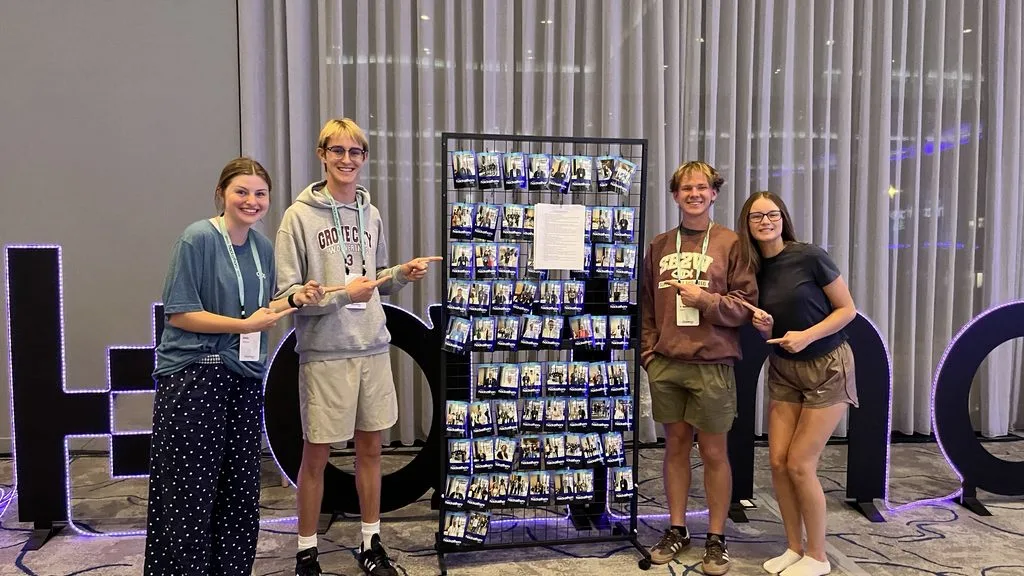
A Grove City College entrepreneurship team returned to the college with a $5,000 “Best Technology” prize from the 2026 Gloo AI Hackathon Oct. 6-8 in Boulder, Colo.
The team — comprised of Nathaniel Davis, Joey Lanzone, Emily Williams and Rebekah Jones — built an app to help people break free from sexual sin.
The annual contest is a three-day event where innovators are judged on their ability “to create AI-powered solutions aimed at advancing the mission of the global Church,” per Gloo, the technology platform sponsoring the hackathon.
As per the competition’s website, the goal is to use technology “to promote human flourishing and organizational thriving within Christian communities.” The prize-winning Grove City team created its app, Reclaim 128, to do just that.
The app, operating off an on-device language model, aims to redirect users from engaging in sexually explicit material with timely redirection. Scanning the data coming into the user’s device, the app determines when content might tempt the user.
It also employs an on-device algorithm that determines whether the user is alone by scanning nearby Bluetooth signals. With these metrics, the app can help predict ahead of time if the user is in a situation where they would be more easily tempted.
When the system detects a present or future temptation, it sends a prompt to the user that suggests engaging with a guided Scripture meditation or calling an accountability partner.
Jones emphasized that the goal was not just to interrupt the user’s action, but to replace it with something else, helping retrain the user’s thought patterns, or, as Jones said, to “interrupt the impulse before it becomes action.”
Jones explained how her social work classes and conversations with professors on campus helped her design the app with both physiological and Biblical perspectives in mind.
Reclaim 128’s central redirection method uses Scripture to replace unwanted habits. Lanzone said this approach received plenty of positive feedback.
“One of the things we learned from real user feedback was that Scripture was super helpful, so we leaned into a Scripture meditation technique called ‘lectio divina,’” Jones said.
LoyolaPress describes lectio divina as “a slow, rhythmic reading and praying of a Scripture passage.”
The panelists also applauded the team for using on-device AI, as its app successfully incorporated a 3-billion-parameter large language model. The function of the team’s AI, however, was secondary to users’ privacy, and it made sure that it included necessary privacy features.
Entrepreneurship professor Robb Myer, who mentored team members throughout the process and went with them to Colorado, was one of the biggest reasons for the team’s success.
“It was super helpful to have Professor Myer to be able to bounce ideas off of and to make sure that both our technology was new and innovative, and that our pitch was specific and targeted towards a need,” Lanzone said.
Lanzone and Davis were also grateful to computer science professor Jonathan Hutchins for helping them tackle the difficulties of on-device AI and encouraging them that their goal was achievable.