By Liliana Shadlow · Staff Writer
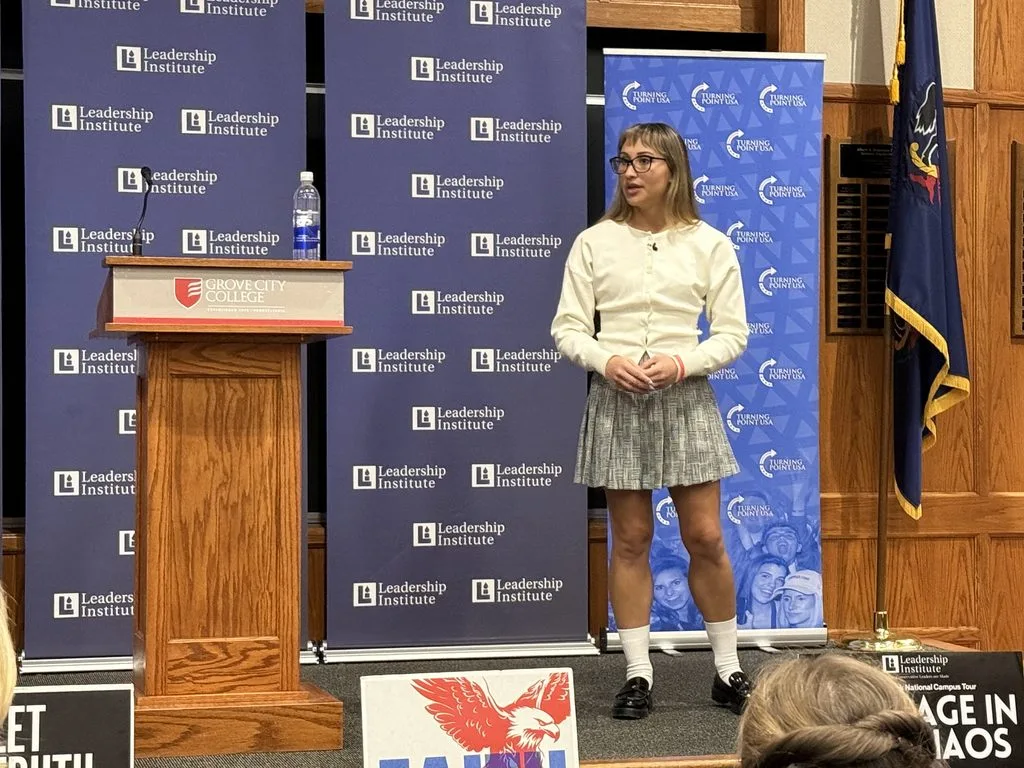
Over 130 students and outside guests filled Sticht Lecture Hall Wednesday to listen to guest speaker Chloe Cole, a gender detransitioner and Turning Point USA-affiliated activist.
Cole, a 22-year-old California native, came to campus as a guest of the college’s Turning Point USA (TPUSA) chapter to share her story as someone who medically transitioned from female to male, detransitioned and now advocates against gender transitions for minors.
“I am excited to have Chloe Cole come on campus and share her incredible testimony with our students and to remind us all how our identity is in Christ and not in the things of this world,” accounting professor and TPUSA chapter advisor Keith Graybill said before the event.
The night’s event began with Cole telling her story of how she went from a young “tomboy” to medically transitioning into a male.
Cole felt more like her brothers rather than other girls from a young age, she said. However, it wasn’t until she hit her teen years that she “believed this was something that took away from (her) femininity.”
Cole said it was through social media that she started meeting transgender children, who “looked just like me. They seemed to find an answer (to) their loneliness … in seeing the world through the lens of being transgender.”
Regarding social media, Cole said, “All I saw was affirmation. And I bought into it.”
Cole spoke on her parents allowing her to transition, saying she didn’t blame them for allowing her to transition. Rather, Cole blames the medical professionals who told her parents that if she wasn’t allowed to transition, she would commit suicide.
“When the options are between death and a cure, (the parents) are going to choose the cure,” Cole said.
So, Cole began medically transitioning at 12, taking prescribed puberty blockers and testosterone. At 15, she underwent a double mastectomy. It wasn’t until after undergoing this surgery that Cole began to have second thoughts.
“I started to question what I really wanted my future to look like,” Cole said.
These ponderings led her to eventually detransition at 16. Cole then started a Twitter (now X) account to share her story with others who might be questioning their gender identity. Today, Chloe is a nationally recognized voice speaking against transgender ideology.
After sharing her personal experience with the movement, Cole touched on what she deemed to be one of the most concerning things about the modern transgender ideology: its target of children. Cole said if minors engage in the surgeries and medical treatments that often accompany gender-affirming care, they inevitably become “lifetime patients” because of the ongoing health risks and complications affiliated with the procedures.
Cole argued the importance of parents remaining proactive in talking with their children about issues related to gender dysphoria before others influence them either in schools or on social media.
“We have to be more vigilant than ever when it comes to our children,” Cole said. “You have to fight for your power as a parent.”
Cole ended the session highlighting the importance of relying on Christian faith through the prevalence of the transgender movement in popular culture.
Guests seemed receptive to Cole’s message.
“Since we have so many people who don’t have a lot of experience dealing with social issues on the ground, (it’s important to see) how pervasive the transgender ideology can be, and how the best way to go about it is to tell people that the best version of themselves is the way that God made them,” Laura Heere, TPUSA chapter treasurer and economics and history major, said.
Ben Uber, a freshman mechanical engineering student, emphasized the importance of protecting free speech on college campuses and allowing a mix of ideas to be shared.
“This topic is very important for our generation,” freshman physics major Jonathan Cooley said. “Transgender issues are widespread; everyone deals with things related to this, and we need to know how to act in this day and age.”
For students wanting to get more information about resources regarding gender dysphoria and medical malpractice, Cole recommended Genspect, Society for Evidence-Based Gender Medicine and Do No Harm Medicine, specifically its Stop the Harm Database.
As for Grove City students getting involved, Cole says the best thing is just to start talking.
“It can (be) as simple as having conversations with people around you,” Cole said.