By Randall Elvin · Entertainment Editor
Can Netflix’s “East of Eden” live up to John Steinbeck’s 70-year-old classic?
His book, rooted in family conflict, jealousy and the ultimate struggle of good versus evil, was published in 1952. If the name sounds familiar, it is because the title “East of Eden” comes from the biblical story of Cain and Abel in the book of Genesis. Hopefully, we Grovers are familiar with Cain killing his brother Abel and then being banished to the land of Nod, east of Eden.
Steinbeck uses this biblical reference to explore the struggle of sinful actions and the possibility of redemption.
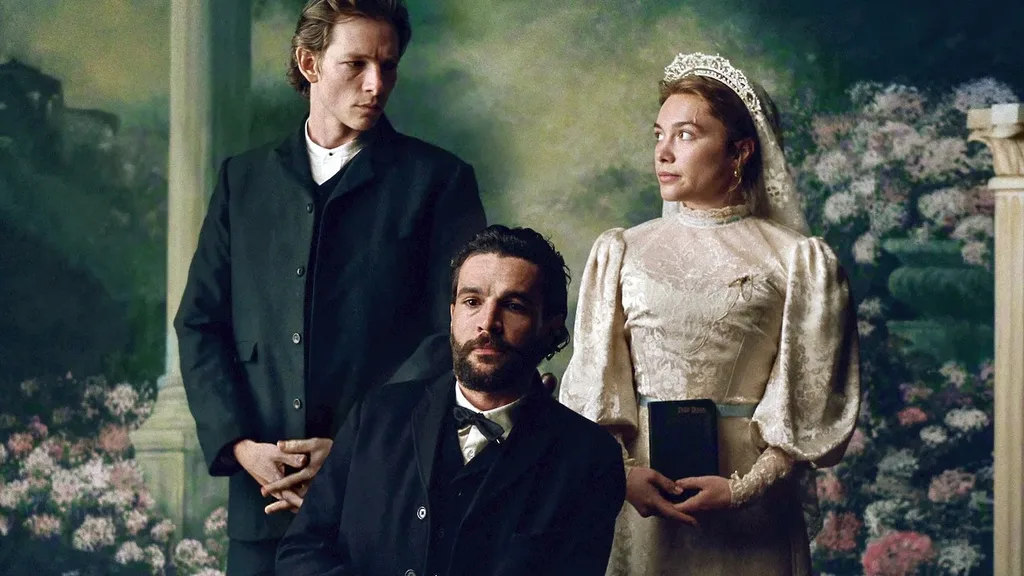
Netflix revives the story by introducing a seven-episode limited series in October. The adaptation stars Florence Pugh as Cathy Ames. Christopher Abbott and Mike Faist also star as half-brothers Adam and Charles Trask.
Rather than simply retelling a classic, the series offers an opportunity to reconsider the novel’s characters and themes for a modern audience. The central question is whether the adaptation can preserve what made Steinbeck’s work so enduring while making it accessible to viewers who may never have read the book.
Set in California’s Salinas Valley, “East of Eden” follows the Trask family across generations. The novel explores complicated relationships between parents and children. The brothers are constantly competing for approval. Individuals struggle to understand their own moral choices. Although its setting belongs to another era, these themes help explain why it continues to attract readers because the conflicts at its center remain recognizable.
Netflix’s adaptation retains these central concerns, presenting a story in which personal decisions and family history shape the characters’ lives. The series also places particular emphasis on Cathy Ames, whom Pugh plays, whose relationships with the Trask family drive much of the drama and who is the show’s focal point.
But they had to decide which characters and perspectives deserve the most attention. This is one of the biggest challenges of adapting a novel. A television series must communicate much of that information through dialogue and visual storytelling, while a book can spend hundreds of pages exploring a character’s thoughts.
Pugh’s portrayal of Cathy is a major focus of the adaptation. Cathy is one of Steinbeck’s most unsettling and complicated characters, and her motivations have long been open to interpretation. By emphasizing her perspective, the series can explore her as more than a source of conflict for the other characters.
The supporting cast also brings familiar figures to the screen. Abbott plays Adam Trask, while Faist portrays his brother Charles. Their relationship establishes many of the family tensions that continue across generations. Hoon Lee plays Lee, a character whose intelligence and compassion provide an important perspective on the family’s struggles.
These performances matter because the story depends on characters who cannot easily be divided into simple categories of good and evil. The more effectively the series communicates their motivations, the more successfully it can preserve the moral complexity that defines Steinbeck’s novel.
The series also has room to interpret the source material rather than reproduce it word for word. Kazan, who wrote all seven episodes, has described the project as an opportunity to explore the novel’s expansive story and its characters more fully. Netflix’s adaptation is therefore not simply a replacement for the book; it is another interpretation of the same material.
A notable difference is how the series approaches Cathy. In the novel, Cathy is often presented as a deeply disturbing figure whose motives remain difficult to understand. The adaptation takes a more sympathetic approach to her background, expanding on the experiences that may have shaped her behavior. This approach does not necessarily excuse her actions, but it encourages viewers to consider whether a person’s choices can be understood through the circumstances that shaped them.
That distinction matters because Steinbeck’s story is not simply about identifying good and evil; it also asks readers to consider human nature and the possibility of choice. By changing how audiences understand Cathy, the series changes how they may interpret one of the novel’s central moral questions, leaving the ending to even larger options of interpretation.
Ultimately, comparing the book and the series requires looking beyond which version is better. The more interesting question is how each medium tells the story and what each allows audiences to understand about its characters.