By Steven Mauch · Assistant Business Manager and Ricky Andrews · Contributing Writer
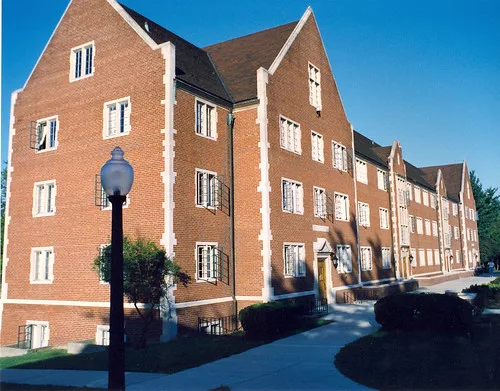
Grove City College is investing in campus improvements by renovating Hopeman and Lincoln Halls and building new athletic facilities.
According to a news release, the college spent $4 million on renovations this summer, with half going to renovate Hopeman Hall. This summer also saw Hicks Dining Hall receive new furniture and a new dining configuration.
As part of Impact 150, which the press release describes as “an ongoing effort to raise $200 million to increase student financial aid, improve facilities, and prepare the college … for the next century and a half,” these renovations target the college and students’ top needs.
For Hopeman and Lincoln Halls, built in 1941 and 1950 respectively, these renovations will be extensive.
“The end goal is to update Lincoln and Hopeman Halls, which would include new restroom and student room finishes, furniture, HVAC, repainting the brick (and) repairing slash replacing the roof and windows,” Vice President for Operations Susan Grimm said. “Once those renovations are complete, a connector between the two buildings would be constructed.”
Grimm mentioned Operations will work with Student Life and Learning to determine what will be in the connector but noted that the Zerbe Health and Wellness Center will move to its ground floor.
“These two dorms have not had much attention over the past renovation efforts,” Grimm said. “The plumbing and restrooms were prioritized due to the condition of the plumbing infrastructure. We look at the number of work orders and the nature of them to determine where we spend the most money on repairs.”
Grimm noted that the communal restrooms in the basement and ground floors of Hopeman were redone over the summer, as well as the main lines running to the building.
Isaac Cooke, the resident director of Hopeman Hall, has seen how these initial renovations have benefited students. While admitting many of these updates are under the surface, Cooke emphasized their central role in preventing flooding, which was common on Hopeman’s ground floor.
“The background structural work, while not seen, is improving students’ daily lives by simply working reliably,” Cooke said. “This may not be a flashy part of the upgrade, but a quiet working bathroom is a welcome upgrade. … Feedback from students has been overwhelmingly positive.”
Connor Owens, a sophomore living in a quad-suite on the first floor with access to both renovated and unrenovated facilities, echoed this sentiment. He compared the old bathrooms to “a 70’s boys locker room from … a TV show,” and said that the new ones are “a lot nicer.” Of the old bathrooms, Owens also complained about other problems such as broken faucet handles and leaking pipes.
When discussing students’ responses to the upgrades, Cooke said, “We’ve even had guys on other halls come down from their halls to use the renovated bathrooms.”
When asked if the renovations solved the problems they intended to, Owens said, referring to the plumbing fixes, “I guess, yes, they band-aided those for now, but there’s still other bathrooms that are not renovated yet that have the same issues.” And the college “probably spends more (money) on maintenance calls at this point than it would have cost them to just fix the bathrooms.”
Hopeman renovations, and the rest of the bathrooms, will be completed over the next one or two summers, as funding comes in, according to Grim.
Renovations in Lincoln will begin after Hopeman’s completion and will similarly depend on funding.
For the athletic facility renovations, however, the timeline is predicted to be shorter, though just as extensive. These updates will include the new baseball field, Stewart Field and the creation of the McNulty Athletic Center. Lower campus will also receive some significant attention with the installation of a new athletic complex.
“A lower fieldhouse that would be the new home to football, lacrosse and tennis is in the design phase,” Grimm said.
As the college has stated, the McNulty Athletic Center will be a “year-round 50,000 square-foot air-supported dome featuring a four-lane track, flexible space for intramural and varsity sports, fitness and conditioning equipment and locker rooms.”
Jeffrey Prokovich, vice president for advancement, said the dome “is being built to benefit the whole campus community.”
“We don’t have the facilities to accommodate all the varsity athletes,” Prokovich added.
Prokovich mentioned that the construction timeline for both facilities should be six months or less.
“The projects are all designed to enhance the student experience,” Grimm said. “Whether they are new buildings and fields or renovations to existing spaces, they in some way benefit students.”