
By Mia Gallagher · Celebrate 150 Correspondent
Celebrating a legacy of faith and freedom
To celebrate Grove City College’s 150th anniversary, The Collegian is exploring the College’s history, traditions and culture in this ongoing series.
What are the qualities of a good leader?
Some lead with levelheaded benevolence. Others rule by fear and force. Still others rely on earned respect and credibility.
The Bible, however, tells us good leaders are stewards of men, individuals who inspire greatness in those they’ve been tasked with overseeing.
This is the style of leadership Christians are called to. And it is this style of leadership that defines the presidency of Grove City College over its 150-year history.
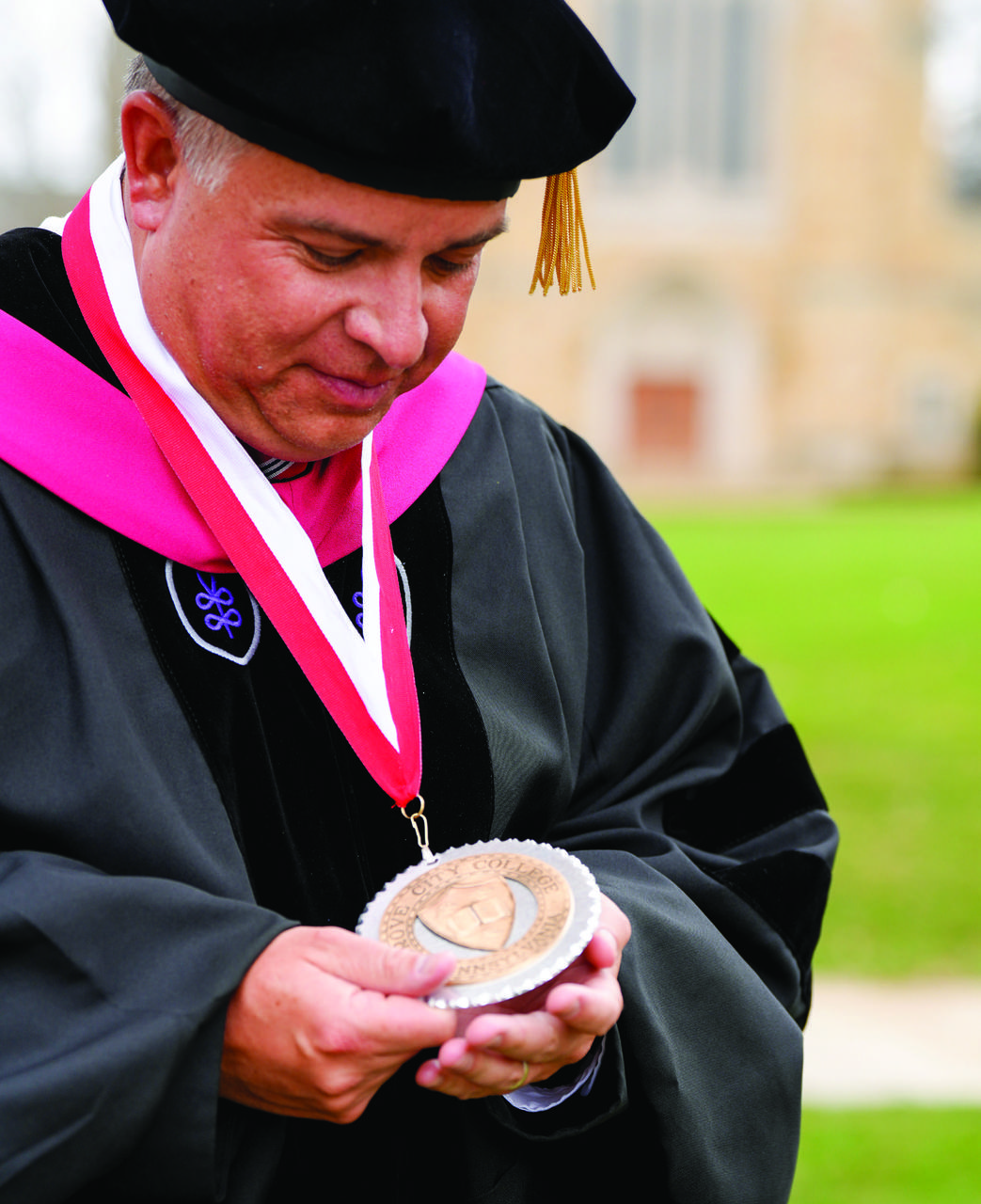
“Each of (the presidents) loved this college and helped protect our commitments to faith, freedom and excellence,” President Bradley Lingo ’00 said. “Their pictures hang in the lobby of my office and remind me that I’m stepping into a story that’s much bigger than any one person. My role isn’t to change who we are, but to care for this place well and pass it on — strong and faithful — to the next generation,” he said.
Just nine men have preceded Lingo, who was officially inaugurated Thursday as the 10th president of Grove City College, and each has had an impact. Two of them – both named Ketler – held office for more than half of the College’s history. Others’ terms of office ranged from a few years to decades.
Who were they? We’re glad you asked.
Isaac C. Ketler: 1876-1913
As the college’s first president, it’s easy to assume Isaac Ketler was this institution’s sole founder. But history tells a different story.
In 1853, local Presbyterian pastors decided to establish a prep school for kids interested in attending college or seminary, which eventually became Pine Grove Academy. In 1876, they hired Ketler, who was just 23, to serve as principal.
“Isaac Ketler had recently graduated from Edinboro Normal School and was teaching in nearby London, Pa., where the outlets are now. His family discouraged him from taking the academy job because it was a risky move going from a stable teaching job to a brand new school. But he had a feeling something more could come from this school,” Director of College Archives and Galleries Hilary Walczak ’09 said.
Under Ketler’s leadership, the small prep school grew quickly into the higher educational institution he and the town of Grove City, which supported the school, believed it could be. With the help of local leaders and industrialist Joseph Newton Pew, Ketler transformed the academy into Grove City College in 1884 and spent the rest of his life building it. When he died in 1913, he had served 37 years.
Alexander T. Ormond: 1913-1915
Upon Isaac Ketler’s death, the college offered renowned Princeton philosopher Alexander Ormond the top job. Ormond sought to elevate and expand the college’s curriculum during his term in office, which was cut short by his death. His efforts yielded new standards, which brought a new level of rigor and excellence to a Grove City education.
Weir C. Ketler ’08: 1916-1956
Weir Ketler, son of Isaac, entered his tenure as the college’s third president at the age of 27, which made him the youngest college president in the country at the time. He led the college for a record 40 years.
“Weir Ketler, funny enough, didn’t really want to become president of the college, but knew that it was his duty. So, he took to fulfilling his father’s vision. One of which was to bring the campus to the other side of Wolf Creek,” Walzcak said.
And fulfill his father’s vision he did. Working closely with J. Howard Pew, the younger Ketler brought in the Olmsted Brothers to plan the construction of upper campus, which was completed during his tenure. He provided solid leadership through decades of change on campus and off.
“Weir was a very logical and levelheaded individual which made him a perfect leader for the Great Depression and world wars. He immediately worked on solutions on how to get the college through,” Walczak said.
J. Stanley Harker ’25: 1956-1971
Alumnus J. Stanley Harker inherited the office at a pivotal time in higher education history. After WWII and the Korean War, college application rates skyrocketed nationally; civilians and veterans alike began to realize the value of post-secondary education. Because of this trend, Grove City’s enrollment grew from 1,200 to 2,056, requiring the college to expand to meet this demand.
Under Harker’s direction, the college met this challenge head on — first with an increase in faculty members, then with an increase in college capital. He oversaw the continued expansion of upper campus and increased the college’s academic offerings and library resources.
Charles S. MacKenzie: 1971-1991
Best known for his stand against federal interference in higher education, Charles MacKenzie guided the college throughout the 1970s and ’80s. The 1984 Supreme Court decision in Grove City College v. Bell, which led the college to cut ties with the federal oversight, was a highlight of his presidency.
But MacKenzie’s accomplishments weren’t limited to that battle. Given his background in theology and education, MacKenzie sought to revamp the traditional model for liberal arts education. From this desire came the Keystone curriculum, an educational model designed to expand a student’s academic prowess beyond the bounds of their major,
“The court case would ultimately be what MacKenzie was best known for,” Walzcak said. “I had the opportunity to interview him a few years before he passed, and he said he had never really intended for it to be that big of a thing. It was not his goal to make it a huge national fight. Something he was truly proud of was the Keystone curriculum that gave a more well-rounded liberal arts education.”
Jerry H. Combee: 1991-1995
Before his presidential term, Jerry H. Combee served as vice president of academic affairs under MacKenzie’s administration. His expertise in educational oversight and reform was instrumental in realizing and extending MacKenzie’s Keystone curriculum — namely, by developing the modern humanities core. Combee also instituted the college’s computer program, whereby all incoming freshmen receive a laptop.
John H. Moore: 1996-2003
With the college cutting its final ties to the federal government in 1996, it fell to Combee’s successor to advocate for the college’s financial health. Enter John Moore, whose term was defined by landmark capital campaigns and campus expansion efforts that propelled Grove City into the 21st century.
In addition to orchestrating the college’s Change and Commitment capital campaign – which raised over $60 million – Moore pushed for international education initiatives and brought internet access to campus. He also oversaw the college’s 125th anniversary.
Richard G. Jewell ’67: 2003-2014
Following in Moore’s footsteps, alumnus Richard Jewell oversaw a capital campaign of his own: Grove City Matters, which raised over $90 million.
Jewell, a phenomenal fundraiser, helped build the college’s advancement office into the fundraising powerhouse it is today. He was deeply involved in the college’s governance before his presidency as a member of the college’s Board of Trustees. Known to some as “Mr. Grove City,” Jewell had an encyclopedic knowledge of the college history.
His term was marked by major campus improvements and the construction of Breen Student Union, STEM Hall, Colonial Hall Apartments and Rathburn Hall. His fundraising efforts also led to increased financial aid opportunities for students.
Paul J. McNulty ’80: 2014-2025
Having been taught by MacKenzie and mentored by Moore and Jewell, Paul McNulty entered his presidential term prepared to build upon their combined legacies.
Throughout his tenure, McNulty oversaw marked improvements to the college’s Christian character, academic excellence and campus infrastructure. His vision and leadership helped establish the Winklevoss School of Business, the Johnson School of Nursing and the Center for Rural Ministry and Center for Faith & Public Life. He spearheaded a major investment in athletics and began the ongoing Impact 150 capital campaign, which has a fundraising goal of $200 million.