
Fennell’s ‘Wuthering Heights’ portrays hormonal fantasy
By Cecilia Landis · Contributing Writer
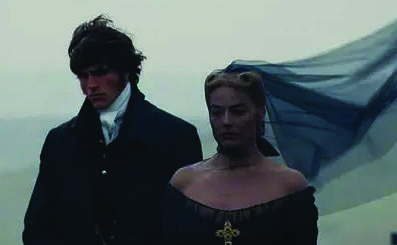
In recent interviews, “Wuthering Heights” director Emerald Fennell has been expressing that her latest film isn’t supposed to be a direct adaptation of Emily Brontë’s classic novel, but instead an imaginative take on the story that speaks specifically to how she experienced the book when she first read it as a 14-year-old girl. Boy, ain’t that the truth.
Fennell’s most recent directorial piece plays out just as you would expect from a hormonal 14-year-old girl’s least morbid sexual fantasies. Stunningly, the film cuts out at least half of the original plot, deserting the story’s most crucial elements at the ‘include-as-many-sex-scenes-as-possible’ altar. In fact, for the half of the story that is told in the film, only half of it is accurate to the original novel. What viewers are left with is 25% of Brontë’s story and 75% of an adolescent’s imaginative sex sludge.
Sitting in the theaters, this was a very disappointing outcome for me. Having read the novel probably around the same time hormonally that Fennell had, my experience with the story was one of simple fascination and disgust. At its core, Brontë’s story involves only the basest forms of human degeneracy and speaks to the gravest dangers of obsession and idolatry. It’s hard even now to fully understand what Brontë’s original intent was with the novel, but it certainly was not written to be the Margot Robbie x Jacob Elordi porno as it has now become.
The film is beautiful, certainly. With its perfectly manicured sets and costume designs, Fennell lives up to our expectation of her as an aesthetically pleasing visual artist. The sets add more to the film than some of the performances from the actors and actresses. The script (having cut out and pasted only the lines 14-year-old Fennell must have deemed fitting enough to keep in à la Thomas Jefferson’s Bible) is appalling at times, and while Robbie and Elordi certainly have their better moments in the film, their skills are hardly enough to keep with the general lack of substance in the screenplay.
One of the biggest complaints from critics about the film (complaints that were circulating even before the film was released) was that Heathcliff, a character who can be translated as a person of color by the book’s description, was going to be played by Jacob Elordi, who is not a person of color. The film does an interesting swap, however, by making Cathy’s (the character played by Margot Robbie) rich husband Edgar Linton (played by Shazad Latif) a person of color instead. This completely reverses what could be understood as the original intention, and like with much else from the book, an aspect which adds greatly to the story and its thematic weight is watered down and taken away completely.
“Wuthering Heights’s” biggest achievement? It very successfully highlights our culture’s fantastic obsession and preoccupation with sex above all else. Having discarded almost every part of the story that marks it as such a singular classic, Fennell’s adaptation would be completely indiscernible from the other slop that we’re fed as a society if it had been given a different title entirely. “Wuthering Heights” reminds us that nothing is as interesting, as consumable or as marketable as sex. Themes of race, gender, wealth or class pale in comparison to this. Nothing means anything anymore if there’s no sex to go along with it. We’re much better off tossing the baby out with the bath water and succumbing to the lusts and desires of our most hormonal 14-year-old-self’s passions (because this is exactly how we’re supposed to experience classic literature at 14 years of age).
This is a harrowing reality. If “Wuthering Heights” is right and that’s what we’ve come to, then I think I really am going to die in this house.