Why does this college have so many staunch friends and supporters? It is because of that long list of strong men and strong women, of diligent instructors, of unselfish workers who through the years have carried on the work here.
By Mia Gallagher · Celebrate 150 Correspondent
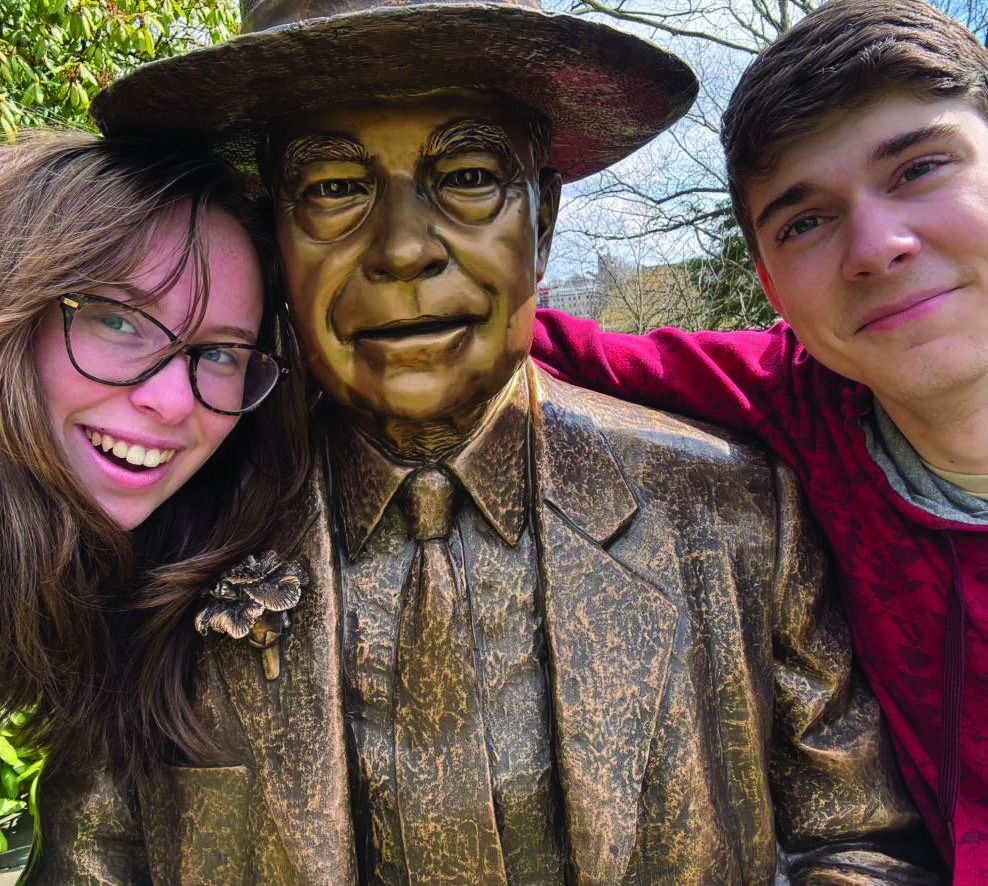
That was the assessment of J. Howard Pew, an alumnus, businessman, philanthropist and longtime chairman of the college’s board of trustees worked tirelessly to build the Grove City College we know today. He, alongside the rest of the Pew family, are among the college’s most celebrated benefactors and visionaries. But while the family’s name can be found on buildings, statues and initiatives all over campus, the Pew legacy is so much more than that.
The patriarch of the Pew family, Joseph N. Pew, was born in 1848 on a farm outside of Mercer, Pa. He began his career journey as a schoolteacher before moving to Titusville, Pa. to invest in the western Pennsylvania oil boom. His storied career in the oil industry culminated in the founding of Sun Oil Co., which is now known as Sunoco.
In 1895, former student Isaac Ketler sought out the successful oil man for help supporting the college that he had founded in 1876. Pew agreed and was elected president of Grove City College’s Board of Trustees.
“We actually had five presidents of the board before J.N. Pew. Often, it’s thought that he is a founder just like Ketler, but he didn’t enter the picture until 1895 well after the College was underway,” Director of College Archives and Galleries Hilary Walczak ’09 said. “[Pew] was however instrumental in the structuring of the board, how to develop funding, connecting the school with benefactors in industry and helping to gather property,” she said.
During J. N. Pew’s tenure as board president, he helped the college reorganize into a nonprofit institution, and the college became a major beneficiary of his philanthropic efforts. Together, J. N. Pew and Ketler worked with the community to build out Lower Campus, but the pair always hoped to expand the college further.
“Joseph N. Pew’s and Isaac Ketler’s goal was to bring the campus above Wolf Creek but neither lived to see it happen. Pew and Ketler would both die unexpectedly a year apart from each other in 1912 and 1913,” Walczak said.
During the 1937 dedication ceremony for Mary Anderson Pew Dormitory, named for Joseph N. Pew’s wife, their son reflected upon his parents’ instrumental legacy at the college. “From its beginnings both he and my mother were deeply interested in the welfare of the struggling little institution which has since developed into the noble establishment that is Grove City College of today,” J. Howard Pew said.
J. Howard Pew, a member of the class of 1900, went on to establish a legacy of his own at the college. Upon his father’s death in 1912, the younger Pew took over as president of Sun Oil and assumed a seat on the college’s Board of Trustees, eventually rising to board chair in 1931.
“J. Howard Pew worked hand and hand with Weir Ketler to bring their fathers’ dreams to life. J. Howard joined the board shortly after his father passed and then would become chair in 1931 and hold the position until his death in 1971,” Walczak said.
“During this time, we hired the Olmsted Brothers firm to design Upper Campus, making us a ‘famous’ Olmsted Campus. Pew and Ketler oversaw a majority of Upper Campus being built during this time. Ketler retired in 1956, handing the reins to J. Stanley Harker ’25. Harker and Pew continued to build out the campus with buildings like Hoyt, Helen Harker Hall, Zerbe, etc.”
Over the decades he was involved in the college’s leadership, J. Howard Pew provided key financial support, often covering budget shortfalls out of his own, deep pockets. He was a major force in creating the religious and political culture on campus and advocating for the same nationally through his support of conservative causes. In the late 1960s, when he perceived that Grove City College was beginning to follow so many colleges and universities down the path to liberalism, J. Howard Pew personally selected Harker’s successor as president and charged Charles S. MacKenzie with reviving the Christian character on campus. J. Howard Pew died in 1971, but the changes he inspired took root and blossomed over the next 50 years.
Throughout the college’s history, other notable Pews have worked tirelessly to advance its mission. Joseph N. Pew Jr., John Glenn Pew and J. Edgar Pew each held positions on the board, and Mary Ethel Pew – for whom MEP Hall is named – helped ensure the Pew legacy would endure for years to come.
“Mary Ethel Pew was a long-standing member of the board and finan cial backing. He was an unrelenting advocate for faith and freedom, and his vision for the college as a leader in both areas was a common theme in his speeches and correspondences.
“It is our freedom that has brought us to this high estate … freedom to dream, to think, to imagine, to invent, to experiment, to match wits in friendly competition. Freedom to be an individual. This is our great American heritage,” he said during the 1937 dedication ceremony for MAP dormitory. He was a major force in creating the religious and political culture on campus and advocating for the same nationally through his support of conservative causes. In the late 1960s, when he perceived that Grove City College was beginning to follow so many colleges and universities down the path to liberalism, J. Howard Pew personally selected Harker’s successor as president and charged Charles S. MacKenzie with reviving the Christian character on campus. J. Howard Pew died in 1971, but the changes he inspired took root and blossomed over the next 50 years.
Throughout the college’s history, other notable Pews have worked tirelessly to advance its mission. Joseph N. Pew Jr., John Glenn Pew and J. Edgar Pew each held positions on the board, and Mary Ethel Pew – for whom MEP Hall is named – helped ensure the Pew legacy would endure for years to come.
“Mary Ethel Pew was a long-standing member of the board at a time where there were next to no women on the board. She, with her sister Mabel and two brothers, founded Pew Charitable Trusts,” Walczak said. The Pew Trusts are major supporters of national and international philanthropy.
“She was instrumental in the Red Cross and cancer research, and pioneered projects assisting Black Colleges. Her long contribution to the college both as a benefactor and trustee member is why she has a dorm named after her.”
As the college reflects on its history this sesquicentennial, the providential role that the Pews played in advancing its mission cannot be understated.
Ketler, reflecting on his colleague and mentor Joseph N. Pew, said, “A great foundation has been laid by men who wrought wisely, and sometimes more wisely than they knew. It is for us who have been left with a great responsibility to broaden and strengthen these foundations and to safeguard and make perpetual in this College those ideals for which these great men have stood, and for the sake of which they gave their time, their money and their strength. Ours is a heritage of more than passing importance.”