‘Swatting’ call prompts lockdown
By Matthew Purucker · News Editor
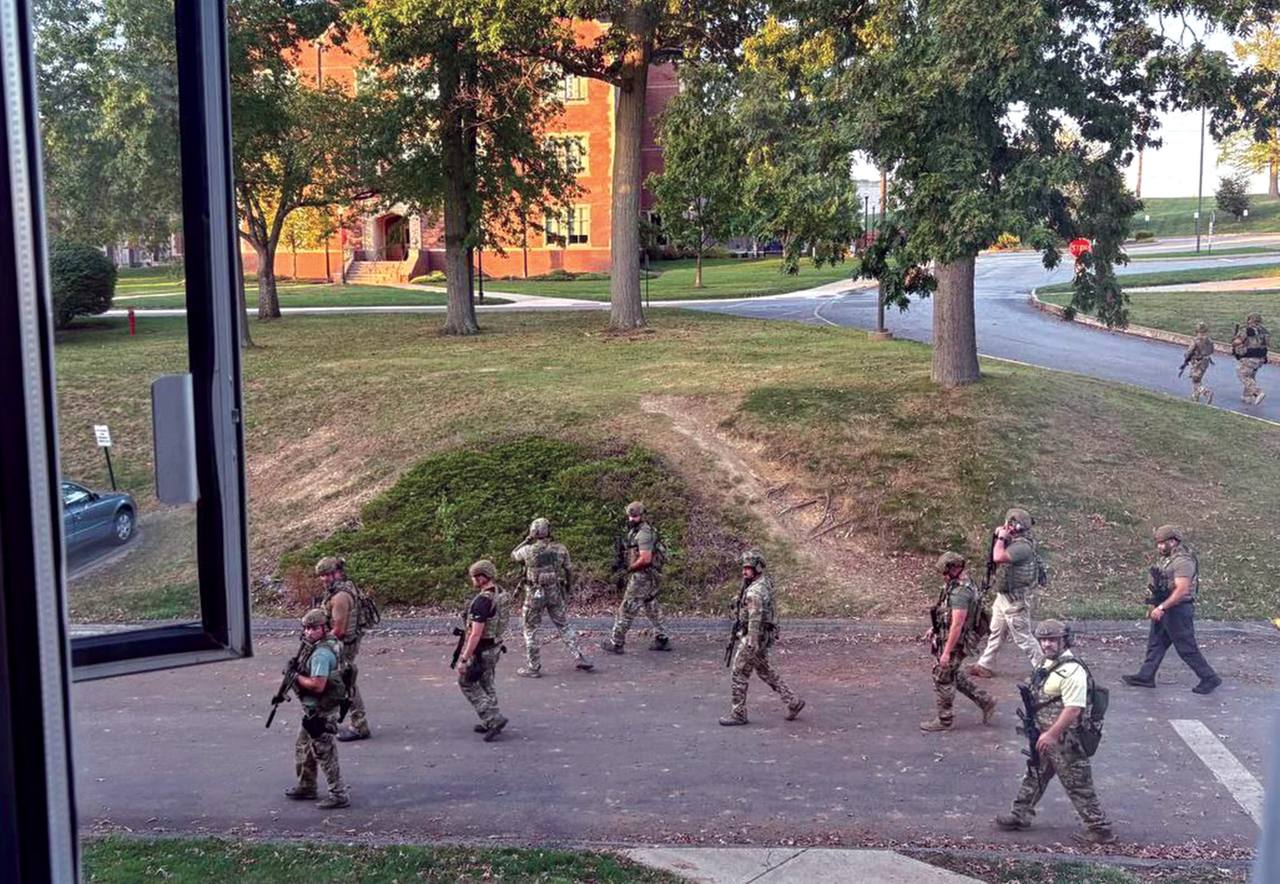
A report of a man with a gun near Buhl Library disrupted Sunday afternoon on campus, drawing a heavy police presence, scrambling students around the area and leading to a three-hour lockdown.
Grove City Police received the call at 3:55 p.m. and dispatched officers, who arrived on campus a few minutes later alongside Pennsylvania State Police from Butler, Mercer and New Castle.
After searching across campus and reviewing security camera footage, police found “no evidence of an active shooter, or victims or witness-es claiming an active shooter was ever present at the library” and said the incident is “believed to be a computer-generated swatting call,” according to a Pennsylvania State Police news release.
Swatting is the act of making a false emergency call to police to draw law enforcement to a location, usually with the intent of causing chaos and harm, as well as distracting or wasting police resources.
“We could not be more thankful for how quickly these local resources arrived or how well they all worked together to bring this to a swift conclusion,” Director of Campus Safety Seth Van Til said.
Soon after arriving, Grove City Police and two Campus Safety officers organized outside Hoyt Hall before entering the library to evacuate students. Almost immediately, students fled in all directions. Some ran to houses along Main Street, while others darted to the IM fields. More students rushed inside residence halls and other on-campus buildings.
“I was (working) behind the desk when two men in police uniforms and ARs (assault rifles) ran through the front doors and began yelling for everyone to exit the building,” senior Christian Paschke said. “At first, I was kind of stunned and didn’t know what was happening.
“Then, I saw three girls sprint past the desk and out the door, and everyone seemed to freak out and started to leave the building. I was praying I wouldn’t hear gunshots, and I luckily never did. Once we got back, it was a kind of eerie scene with shoes left behind around campus, along with earbuds, phones and wallets that were left around the library until students were walking around again.”
Although students near the front of the library exited without much trouble, students farther back had a much tougher escape. Students first tried leaving through the emergency exit doors on the first and second levels, but after being unable to open them, students dove out windows on both floors.
Junior Hayley Oakes, who jumped out of a second-story window, suffered what she said was a “minor leg injury” and had to go to a local emergency room.
“In that moment, I truly believed I might die. It’s been hard since then because many people don’t understand what it was like to feel that fear, to think it was really happening and to experience those overwhelming emotions,” Oakes said. “I never imagined I’d have to make a split-second decision like throwing myself out of a library window, injuring myself just to get to safety.”
The Collegian, as well as state, local and campus police, did not receive reports of other injuries.
Emergency exit doors automatically unlock during a fire, but Van Til said a red button beside the door “must be pushed” to unlock in other emergencies.
College President Bradley Lingo said that the Operations Department confirmed the emergency exit doors worked when used as intended.
“If you’ve never operated the emergency exit door before, which most students would never had occasion to do, and you’re panicking and under pressure, it’s possible that you would not understand how to operate that emergency exit door,” Lingo said.
Once police started clearing students out of the library, students began communicating about the threat of an active shooter.
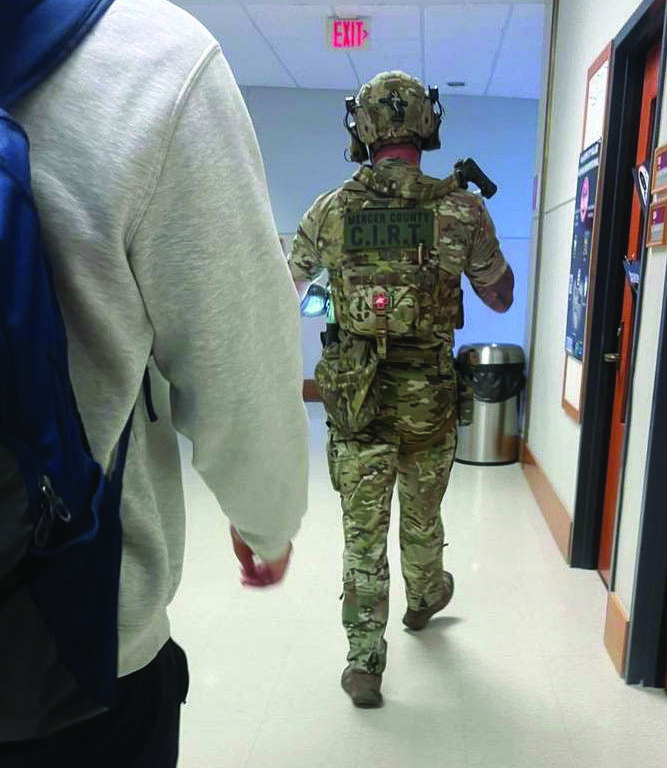
After not finding the alleged active shooter, more state and local police reached campus at around 4:10 p.m. That allowed law enforcement to divide into multiple teams to expand the search to Hicks Cafeteria, Pew Fine Arts Center (PFAC), Stanley Hall, STEM Hall and other campus buildings to look for the alleged shooter and search and evacuate students. One of those newly arrived units, the Mercer County Critical Incident Response Team, investigated PFAC.
The college first officially alerted students through an email sent at 4:29 p.m., which said, “Police are investigating a potentially dangerous situation at the GCC library. Lock yourselves inside and away from the library.”
The college emailed students twice in about 90 minutes following the first email with updates. One “issued a precautionary lockdown” for the campus, while the other told students to “continue to shelter in place.”
Campus Safety “lifted the precautionary lockdown” in a 6:54 p.m. email alert.
After the campus ended the lockdown, Lingo addressed the college with two emails late Sunday evening to inform and comfort students.
“I wanted to make sure that (students) knew that there was not, in fact, someone with a gun or a shooter on the campus, that we weren’t the only campus that was affected by a swatting call and, most importantly, that there were resources at the Christian Formation Office and Student Life Office to help them,” Lingo said, referencing the similar false calls that West Chester University, Shippensburg University and Millersville University received the same day around the same time.
“We were fortunate that this did not result in any loss of life or injuries from a shooter, but there’s still emotional trauma (about) an unsettling series of events. And (I was) making sure that the students knew that there was help available for them.”
Following the incident, Van Til said Campus Safety “held several after-action debriefings” to discuss adjusting safety policies, but the department has not finalized potential changes.
Lingo also created a special committee, which Vice President for Operations Susan Grimm and Vice President of Student Life and Learning Larry Hardesty will lead. It will analyze this incident and recommend areas to improve, so the college can be better prepared for similar events in the future.
“The silver lining to this event, as unsettling and challenging as it was, is we couldn’t have possibly created a better drill to assess our preparedness,” Lingo said. “So we’re going to be taking advantage of this opportunity to assess every aspect of our response to the event and think about how we can even be more prepared in the event that something like this were real.”