
International students make their mark on campus
By Jaci Morrell · Contributing Writer
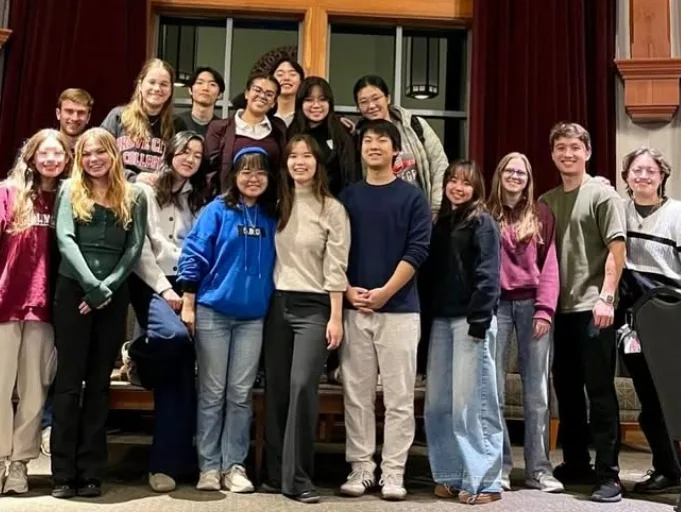
Many Grove City College students live far from their family, but few come from as far as Chinese international students, who live an ocean away from home.
According to Statista, around 265,000 Chinese students have chosen to study in the United States, with 11 studying at Grove City, making up about 30% of the international student body. Despite making up a fraction of the overall student body, students from China have made an impact far greater than their numbers suggest.
Chloe Wilhelm is the director of the Imago Dei office, a department of the college dedicated to aiding international students, green card students and missionary children in adapting to the college environment in the United States. She described her job as centered on “connection and relationships,” listing several possible difficulties international students face, from increasingly strict visa requirements to the lack of English second-language resources on campus.
With such a dramatic culture change, Chinese students have learned to adapt to an American way of life. One key part of the switch from China to the United States is the name change. Most Chinese international students use an English name for their time in the States because their Chinese names are often too difficult for Americans to pronounce.
Wang “Andrew” Nanxi is a freshman studying English at Grove City. Originally from Nanjing, he chose to attend Grove City College because of its values and rigorous academic requirements. He has been impressed by how welcoming the campus has been, although the American custom of using “how are you” as a greeting was initially confusing to him.
“I wondered, ‘Why is everyone so friendly?’” Wang said. He’s since learned the correct response is to say “fine” or “good.”
Wang’s favorite thing about campus is the natural environment, as it’s a huge change from his urban life in Nanjing. Wang remarked that back home, it sometimes “feels like the ground was always cement, and the grass is what’s intruding.” He enjoys the wildlife here on campus, such as the squirrels, which are not present in China.
Wei “Berkeley” Xiangbo, also from Nanjing, likewise found the difference between urban life and the rural life of Grove City to be a stark change when immigrating. Some aspects of American humor also proved to be a hiccup.
“Sometimes people laugh, and I don’t know why they laugh,” Wei said, explaining some differences between American and Chinese senses of humor. He sometimes has to “try to be as American … as I can,” and sometimes, that means laughing at things he doesn’t find funny.
The largest hurdle for the students, however, was the food. Wang did not speak highly of the food on campus, saying it was “hard to get used to,” and Wei found it was “too unhealthy.”
Zhou “Sarah” Yutian, president of the Pan Asian Association (PAA), said that, for Chinese students, food is often “not just the thing you eat. … It carries so much of the culture.”
In China, food is integral to celebrations and holidays, and most families eat at least one meal together every day. All three students preferred MAP cafeteria over Hicks.
Being a foreign student comes with challenges. Zhou had to “try extra hard to reach out.” Zhou encouraged American students to help bridge the culture gap, even by doing something as small as asking a Chinese student to get lunch.
For students wishing to learn more about Asian culture, PAA is hosting its Mid-Autumn Festival Saturday. All students are invited to enjoy Asian food and take part in activities from lantern-making to calligraphy practice.