By Liliana Shadlow · Staff Writer
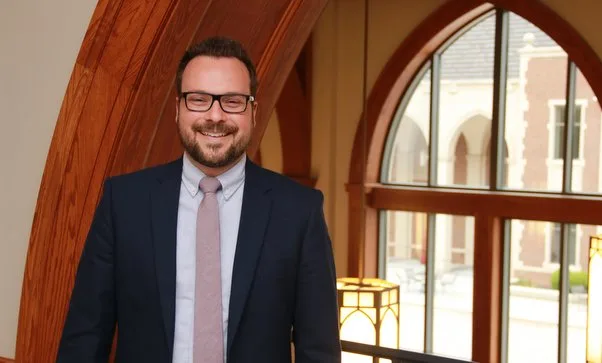
“Very little of your digital technology is optimized for your flourishing,” Grove City College philosophy professor Christopher Franklin said Monday.
In a world that seems consumed with technology, Franklin offered a different approach: digital minimalism.
“Not a lot of us need convincing that digital technology produces a problem,” Franklin said.
However, the problem many people face is wondering what to do about their overuse of, or even addiction to, the digital universe.
Facing a room full of eager listeners, Franklin asked students to consider two questions about their technology use. Does your digital technology support human flourishing, and if so, does it “strongly” support human flourishing?
According to Franklin, the addictive algorithms, constant social comparison and hours spent caught up in online relationships are the result of over-immersion in the online world. Franklin noted that the real danger with technology use isn’t what we’re doing, but what we aren’tdoing. Every hour spent online is an hour not spent developing real-life relationships, learning a new hobby or cultivating the mind.
“Technology is only important insofar as it opens up what we can do,” Franklin said.
What we can do with technology can be significantly less important than what we could do if we took time to unplug, look around and focus on the here and now.
Franklin encouraged everyone to do a 30-day technology fast — cutting out unnecessary tech for 30 days. No social media, no phone alarm clocks, no Google Maps. Anything that isn’t needed for “professional success” or “basic daily survival” would need to be deleted or, if you have an incredible amount of willpower, avoided for 30 days.
While Franklin acknowledged the withdrawal people would experience initially, he emphasized the restfulness that would eventually come with a break from the constant noise of the online world.
Students seemed to receive “In Defense of Digital Minimalism” well.
“Given that our lives are infiltrated with both good and bad technology, I think it is very important to balance and discern what is good technology and what is practical and useful, while also maintaining a healthy balance in recognizing when it has been bad for our souls,” senior philosophy major Kaitlyn Rumbuc said.
Freshman mechanical engineering student Alex Farrey touched on the importance of taking individual responsibility for our online activity.
“We get to decide where our values lie,” Farrey said. “As a STEM major, a lot of my STEM classes have digital homework (and) digital resources; it’s not helping us stay away from the digital world. There are proven studies that reading something that involves scrolling leads to your brain retaining less information.”
Junior history and philosophy major Christopher Garrett said he would love physical textbooks, as well as physical IDs, to make a comeback.
“I learn so much better with physical textbooks,” Garrett said. “If we can keep our phones doing less things for us, we can be less tethered to them.”
In a post-lecture interview, Franklin spoke on how he sees technology addiction at the college.
“One way in which I see students dependent on (technology) is the moment they walk out of class, walking down the stairs, bumping into other students, they’re on their phone,” Franklin said.
He also spoke on the impact of technology on attention span and productivity.
“Some students are petering out on abilities that are there but never actualized because of their engagement with digital technology,” Franklin said.
More than just using less technology, Franklin promoted intentional times away from the noise and chaos of the political and social world. Franklin said spending intentional time in silence is when our minds can best think.
“Silence and solitude are the laboratory of the soul,” Franklin said.