
By Randall Elvin · Entertainment Editor
Class is over. You just discussed ethical issues in SSFT with Dr. Anderson, learned new Spanish vocabulary with Dr. Studeny or explored finance concepts with Dr. Truitt. You walk back to your dorm, sit at the desk that has been in that dorm for generations and pull out your source of entertainment. No studying is done and no time is spent with friends. All because your head was stuffed in that stupid … newspaper? One hundred years ago, that could’ve very well been the picture (minus our contemporary professors) because TikTok, Reels or even TV did not exist. So how did people consume entertainment over the last 100 years?
In 1926, entertainment was something you had to seek out. The central source of information and entertainment was in the newspapers. Comics, sports, stories, movie listings and celebrity information were all in the papers. Many people read the newspaper religiously and would not miss a copy.
But that wasn’t the only source of entertainment for long. The radio’s reach was also growing. Voices, music and live broadcasts could be consumed audibly. It is important to note that you couldn’t listen to whatever you wanted, whenever you wanted. You had to wait for the scheduled time that your preferred music, game or commentary came on. Together, the newspaper and radio entertained people for plenty of hours a week.
Imagine a college student coming back to their room in 1946. Instead of grabbing a newspaper, they turn on the radio. Suddenly, the room is filled with music, comedy, drama, sports and news. But the outcome is the same as when students are distracted today: no homework is completed and no sleep is had.
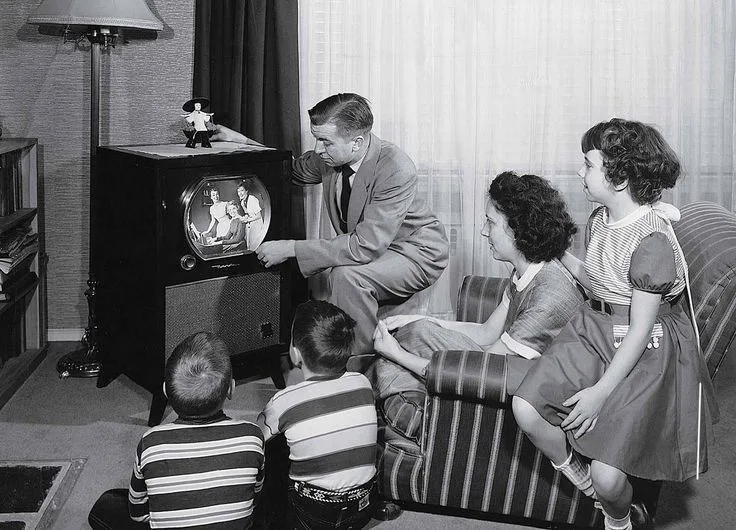
By 1966, the radio had some serious competition. By then, televisions were common in households. Television gave viewers sitcoms, dramas, variety shows, sports and news without requiring them to leave the house. Entertainment was no longer only reserved for print and audio. For the average person, the evening could revolve around one question: “What time does it air?” This became especially true for shows like “Batman” and “Star Trek,”which became cultural icons. This created a feeling almost entirely forgotten in the age of streaming: sitting around the television and watching the same live program together. Entertainment was still scheduled. If “Batman” came on at 7:30, you watched it at 7:30. If you missed it, you missed it.
Unlike today, televisions were typically shared by one family, so everyone had to agree on what to watch, and dorms did not usually have TVs. However, moving into 1986, entertainment became more personal. Instead of everyone needing to listen to the same radio station or watch the same television program, people could carry their entertainment with them. This is when the Walkman “walked” onto the scene. For the first time, you could put on headphones, press play and create your own entertainment bubble. When a student walked around campus, they could listen to their favorite music without forcing everyone else to listen to it with a boombox on their shoulder.
Then the VHS came onto the scene. Movies were now rentable and rewindable. Movies could fit into your schedule, not the other way around. It seemed like entertainment couldn’t be easier to access.
Then came the internet. By 2006, entertainment was a click away.
You could sit at your computer and watch videos on YouTube, listen to music through iTunes, customize your MySpace page or put hundreds of songs onto an iPod. Entertainment became something you chose. Instead of waiting for entertainment, you were searching for it.
Ten years later, even the computer was becoming unnecessary. The smartphone had taken over. By 2016, your phone could essentially replace half the entertainment devices that existed throughout the previous century. It was your newspaper, TV, radio and music player. Apps took over the need for different devices. Netflix meant you didn’t have to wait for television schedules. Spotify meant you didn’t have to wait for the radio to play your favorite song. YouTube meant you didn’t have to wait for a television network.
Now we arrive at 2026. You don’t need to look for entertainment anymore. It comes looking for you, the second you open your phone. A new song. A new episode. A new story. An infinite pool of videos just a swipe away. Instagram and Snapchat can now feed you endless entertaining content. It went from what to watch to what not to watch, due to the volume of entertainment at our fingertips.
Over one hundred years, entertainment has gone from something we had to seek out to something that is constantly within reach. What once required a newspaper, radio, television or computer can now be found instantly in the palm of our hand, ready to distract any college student.