
By Maddie Miller · Contributing Writer
With humidity reaching maximum levels across Pennsylvania, neither students nor college dorms are handling the heat well.
From Aug. 29 through Sunday, nine nights of 14 reached 100% humidity. Grove City is experiencing heat so intense that not even sweat can evaporate.
“Kind of feels like a bit of a sauna in there,” junior Hannah Jasko, a resident of Mary Anderson Pew Hall (MAP), said. “I do a lot of my work in the room, so it’s my place where I get to focus. But since it’s so hot in there, that kind of impairs my focus. And also, especially at night, it’s the most impactful when you’re trying to go to sleep.”
As no dorm has air conditioning, this sentiment is common throughout campus.
“Sleeping with it is the worst,” senior Jack Davis, a resident of Ketler Hall, said. “It just makes living in the dorms uncomfortable, or just staying in there. I typically have to combat the heat through opening the windows; bugs get in, and that’s frustrating.”
While unable to do anything about the weather, the college has heard the complaints.
Susan Grimm, vice president for operations, offered guidelines to students to maximize nighttime cold air and keep out the afternoon heat.
“At night when it’s cool, if you open your window and put a fan in it, it will draw in the cool air,” Grimm said. “During the day when you are at class (and it’s hot outside), close your windows and pull down the shades.”
However, if following these guidelines does not sufficiently reduce heat, the only way to be allowed an air conditioning unit is through Disability Services. According to the air conditioning request form, “The student must submit current medical documentation from a pulmonologist, allergist or other relevant licensed medical professional, which supports the student’s medical need for air conditioning.”
If students successfully follow this process, they still must provide their own air conditioning unit.
While renovations occur in other areas of campus, Jeffery Prokovich, vice president for institutional advancement, explained why air-conditioning systems will not be installed anytime soon.
“Our residence halls are not designed for air conditioning, and, given their age, this installation would be extremely difficult and extremely expensive,” Prokovich said.
Grimm agreed.
“Even the addition of window units would be cost-prohibitive because the electrical requirements to support that effort would be very high. When the buildings were built, there were not as many electrical demands on the building,” Grimm said.
The electrical needs of modern devices and appliances make adding air conditioning more unfeasible, Grimm said.
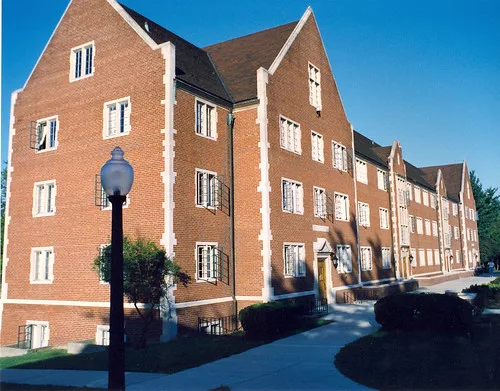
Most of the dorms were built 50 to 100 years ago, and Jasko and Davis live in the two oldest halls (89-year-old MAP South and 94-year-old Ketler). The dorms’ brick structure and summer’s seemingly unrelenting humidity collaborate to turn rooms into insulated, cooling-resistant chambers.
For students struggling to get the eight hours of suggested sleep, these conditions can be particularly harmful.
As National Sleep Foundation research has found, colder temperatures tend to encourage quality sleep more than hotter temperatures do, and sleeping too warm “can increase wakefulness and interrupt important phases of your sleep cycle.”
Such interruptions can cause memory issues, difficulty focusing and emotional dysregulation, according to the National Institute of Health.
For Jasko and Davis, a plausible fix seems unlikely.
“Other than implementing air conditioning into the buildings, I’m not sure that anything else would really help,” Jasko said.
“I just really hope there is a solution,” Davis said.