
By Emily Fox · Editor-in-Chief
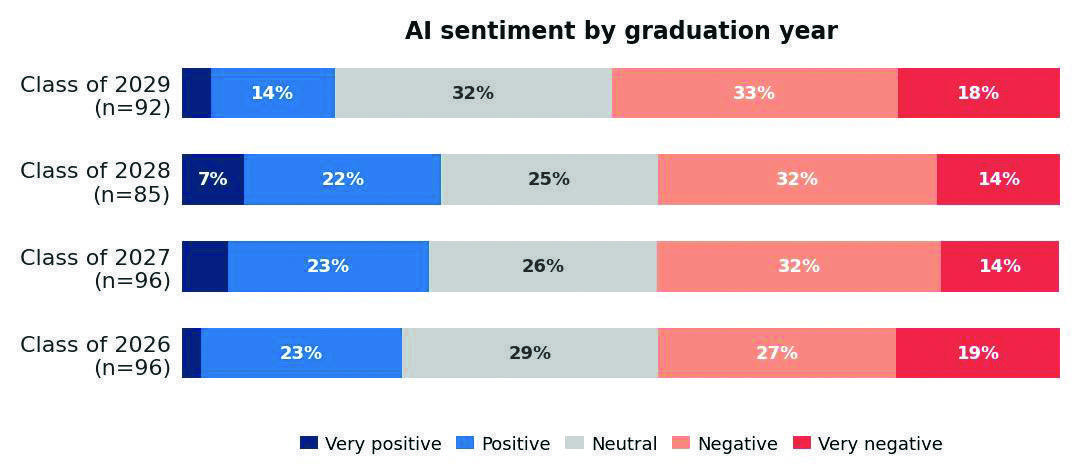
The Collegian poll conducted last week found that more Grovers hold negative associations with artificial intelligence (AI) than positive, with 46% of the 377 students polled responding that their associations with AI were negative or very negative, while only 25% responded positive or very positive.
The poll revealed Grovers are more optimistic about the opportunities AI might create than numbers found in national surveys. Grovers do not think AI should be used to write sermons; they use AI for companionship at much lower numbers than other college students, they primarily use AI for summarizing and gathering information and are mostly opposed to using AI for creative tasks.
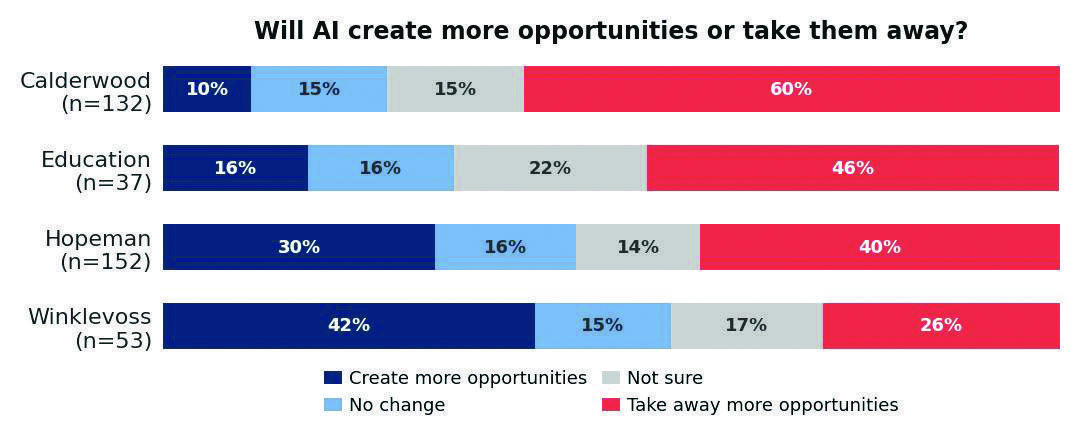
The Collegian found that when asked whether they believed AI would create more opportunities for them or take away more opportunities, 46% thought it would take away more opportunities, and 23% thought AI would create more opportunities.
However, Grovers were more optimistic than college students nationally. Comparatively, the Fall 2025 Harvard Youth Poll reported that only 16% of college students polled believed AI would create more opportunities for them, and 45% believed it would take away more opportunities.
There is a stark contrast between poll respondents belonging to the Calderwood School of Arts and Letters and the Winklevoss School of Business. Sixty percent of Calderwood students believe AI will take away more opportunities for them, while only 25% think it will create more opportunities. Twenty-six percent of Winklevoss students think AI will take away more opportunities, and 42% think it will create more opportunities.
“Business students see AI the way most professionals now do, as a tool that, used well, expands what is possible,” Assistant Professor of Business Analytics Ryan Miller said.
Miller went on to explain that this perspective explains why Winklevoss students have higher AI usage rates and are more optimistic about the opportunities AI might create.
“AI (is) a natural instrument for them,” he said. “They are focused on things like efficiency, productivity and increasing profitability, and they are preparing for professional environments where AI fluency is already an expectation.
“What I would caution against is reading this as a story where one group is simply right and the other wrong. Arts and humanities students are often working from a different tradition, one that understands education as praxis, the kind of formative action That constitutes the person doing it,” Miller said. Miller noted that for humanities students, writing is the medium through which they come to know what they think, and reading carefully is the cultivation of habits of attention.
“Their skepticism is not fear, and it is not ignorance. It is a serious instinct about what we lose when we reduce education to its instrumental value,” Miller said. “Both anthropologies have genuine roots in the Christian tradition, and both deserve a fair hearing.”
The Hopeman School of Science and Technology falls between the Calderwood and Winklevoss schools, with 40% responding that AI will take away opportunities and 30% responding that it will create more opportunities. Education majors primarily believe AI will take away opportunities, with 46% reporting it will take opportunities away and 16% reporting it will create more opportunities.
Most Grovers are against the use of any AI in church. Ninety-four percent of respondents believe AI should not be used to write sermons, 93% are against the use of AI to write prayers and 71% are against using AI to edit liturgy, sermons or prayers. However, students seem to be more accepting of using AI to research sermon material. Thirty-one percent of students believe AI should be used to research sermon material, while 50% do not think it should be used.
Grove City students are more against using AI to write sermons than the national average. A Lifeway Research study found 44% of Protestants do not see anything wrong with pastors using AI for sermon preparation. Forty-three percent disagreed with using AI for sermon prep.
The Collegian found that 48% of Protestants polled are against using AI to research sermon material, and 95% were against using it to write sermons.
Freshmen have the most negative associations towards AI compared to other class years. Over half (51%) of freshmen polled responded that their associations with AI were negative or very negative, while only 17% responded that their associations with AI were positive or very positive.
Men were found to have much less negative associations with AI than women. Only 33% of men reported negative associations with AI, while 58% of women reported negative associations. Thirty-seven percent of men responded positive or very positive compared to 15% of women.
Though the plurality of Grovers responded that they have negative associations with AI, most students also responded that they use AI weekly. Thirty-nine percent of Grovers use AI one to three times a week, 12% use it five to 10 times a week and 13% use it more than 10 times a week. Thirty-five percent of Grovers do not use AI at all.
Students belonging to the Winklevoss School of Business use AI most frequently; ninety-two percent use AI weekly. Education majors use AI the least, with only 43% of education majors using AI weekly. Seventy-six percent of students belonging to the Hopeman School of Science and Technology and 49% of students belonging to the Calderwood School of Arts and Letters use AI weekly.
The division was close between Grovers who believe AI literacy should be a mandated outcome of college education and those who don’t. Thirty-eight percent think AI literacy should be a mandated outcome, and 42% think it shouldn’t.
Grove City College English Professor Jeffrey Bilbro has published articles about AI and humanity in several academic journals and spoken about AI at a conference at Whitworth University. He commented that the close numbers reveal a desire within the student body to understand how AI will interact with their lives and vocations.
“I think it shows students know even if you don’t like it, you know that it’s part of the world that we live in and want to understand how to use it in targeted ways, or understand how it’s going to affect their lives or be able to talk about it intelligently,” Bilbro said. “So, I think it’s possible to be skeptical and not like it and yet still think ‘I should know more about this.’”
The poll also showed that most students (68%) think that AI should sometimes be permitted or encouraged in college study. Only 6% think it should always be used, and 22% think it should never be used.
These numbers encouraged Bilbro.
“I’m encouraged by that, that students recognize ‘I want to learn, I want to be formed, I don’t want to offload cognitive formation to AI.’ … ‘There are targeted ways of using it that are discipline specific or work-force related that I want to understand,’ so I’m encouraged by students mostly having a sense of discernment there,” he said.
Grovers primarily use AI for research and to summarize information. Seventeen percent of students polled frequently use AI for research, and 34% occasionally use it for research. Sixteen percent use AI frequently to summarize information, and 36% use it occasionally.
The poll found that only 2% of Grovers use AI for companionship, numbers that are much lower than those in other surveys conducted with young people.
Bilbro acknowledged that the low number of Grovers using AI for companionship is not the norm.
“That is not normal. Not normal at all. I hope that part of it is that you’re at an in-person community that has relatively healthy social norms, and so people feel less lonely,” Bilbro said. “The numbers of young people who use it for companionship are a lot higher on a national average.”
In February 2026, Syracuse University Today reported that a survey of 18 to 25-year-olds found 360 of the 1,500 polled use AI for romantic companionship long-term. Many claim to use it to “practice” for real romantic interactions with other people.
Students think it is ethical to summarize information, write code and collect information. Seventy-two percent of poll respondents think it is ethical to summarize information with AI, 57% think it is ethical to write code using AI and 48% think it is ethical to use AI to collect information.
Students largely think it is unethical to use AI for academic writing submitted for a class, for creative writing, to compose music or write lyrics, 49% said it was not ethical to use AI to create images or art and 45% thought it was unethical to use AI to produce corporate content.
Eighty-five percent responded that it is not ethical to use AI for academic writing submitted for a class, 66% believe it is not ethical to use AI for creative writing, 65% do not think it is ethical to use AI to compose music or write lyrics, 49% said it was not ethical to use AI to create images or art and 45% thought it was unethical to use AI to produce corporate content.