By Julia Kramer · Contributing Writer
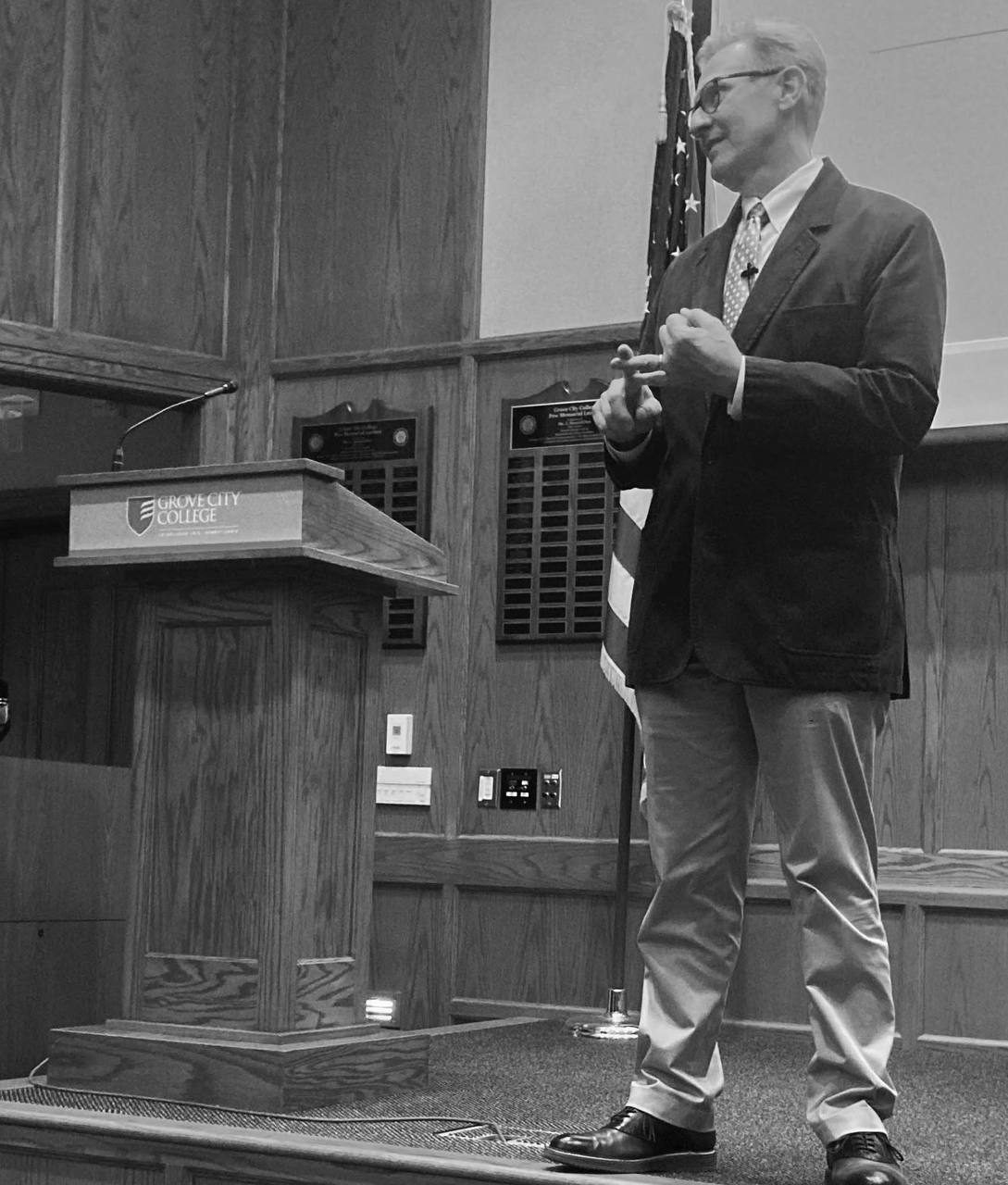
James Otteson, a professor of philosophy and business at Notre Dame, discussed how to practice business honorably in Sticht Lecture Hall on Oct. 23.
Otteson lectured on “honorable business,” the same name as his 2019 book, promoting a countercultural argument to the zero-sum gain commerce theory. Otteson addressed that many perceive his topic as an oxymoron and believe students who pursue business are only out to make money to the detriment of society.
“People see business profit as necessarily in conflict with the social good,” Otteson said.
This is not a conventional topic for a business lecture, which was why he was asked to come and speak.
“What I really wanted students to grasp are some of the philosophical underpinnings of what it is that they are doing when they are entering the business world,” Associate Professor of Economics Caleb Fuller said.
However, Otteson argued that for there to be a “just and humane society,” the world needs a “properly functioning market economy.” He further stipulated that this economy could bring genuine value to the world by improving the lives of others through honorable business. Then Otteson transitioned to build the case that this genuine value is only made through cooperative behavior.
“People (falsely) think, sort of instinctively, that if you are successful, it will have to come at somebody else’s expense,” Otteson said.
Otteson also posed the two main ways people get things from others: taking and asking. Otteson then discussed that for much of history, from the pharaohs to the Romans, humans have chosen the “take” option.
“Conquer, usurp, take, steal,” Otteson said. “That’s what we (humans) do.”
However, Otteson pointed out that this approach only results in a “zero-sum transaction” that never creates new value. Moving around wealth does not create value, and in cases of war, it often results in negative value. Otteson revealed that this economic trend shifted after the 1800s.
Going from $3 earned a day to $56, humanity has never been richer than it is today, according to Otteson, who challenged the audience to guess what changed. After allowing students to try and puzzle through it themselves, he shared what he believed to be the explanation behind this huge economic shift, or “Great Enrichment.”
“It’s not in institutions,” Otteson said. “It was a shift in morality.”
Per Otteson, people learned that it was only through moral, cooperative exchanges, where both individuals benefited, that true wealth and value could be brought into the market. Otteson then argued that it is this truth that is the basis for “honorable business.”
Otteson highlighted that businesspeople not only should reject extractive or taking practices, but they should also engage in genuine cooperation and treat people with the respect that is best for them.
“An honorable businessperson should always strive to behave honorably, no matter what, even when people around (them) are not doing it,” Otteson said.
“I think it’s important for students also to think about what the lines are: Think now, ‘what are the lines I will not cross, no matter what?’ And when you come up with a couple of those, don’t cross them.”
Otteson demonstrated that business, like any other degree or occupation, can be pursued, not merely for personal or material gain, but to bring “genuine value” into the world.
However, understanding what role business can play in a Christian’s life is not something that can be summarized in one lecture.
“Use your unique time, talent and treasure to benefit not only yourself, but others,” Otteson said.